
Why Did AP Avoid “MoonSwatch-ification”? The Luxury Strategy Behind Royal Pop
Why Did AP Avoid “MoonSwatch-ification”? Luxury Strategy Behind Royal Pop
The success of MoonSwatch symbolized the “democratization” of luxury watches. However, Audemars Piguet × Swatch’s Royal Pop appears to pursue a fundamentally different objective.
Rather than creating an accessible version of the Royal Oak itself, AP deliberately maintained distance from its core collection through an experimental pocket-watch-inspired design. This distinction reveals a deeper contrast in luxury strategy, brand equity management, and the monetization of intangible assets.
Following is the Royal Pop display at Ginza store.
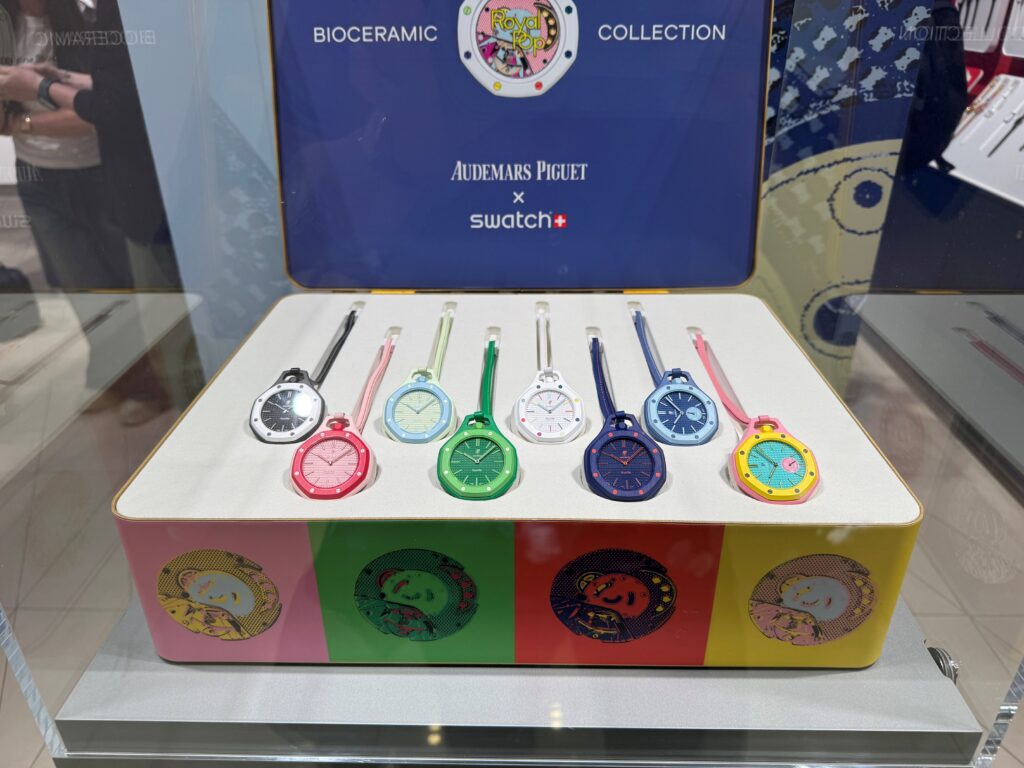
Chapter 1 — MoonSwatch and Royal Pop Are Similar Only on the Surface
MoonSwatch was ultimately an internal collaboration within the Swatch Group. Omega and Swatch share the same corporate ecosystem, allowing the group to manage pricing, production, brand risk, and profit allocation centrally.
Royal Pop, by contrast, represents a collaboration between independent entities without shared ownership structures. That difference materially changes the strategic risk profile.
MoonSwatch focused heavily on commercial expansion and younger customer acquisition. Royal Pop, however, appears designed primarily to preserve Audemars Piguet’s mythology while selectively broadening cultural relevance.
Chapter 2 — Why AP Avoided Direct “Democratization” of the Royal Oak
Audemars Piguet operates on an extreme scarcity model. In many ways, the inability to easily purchase a Royal Oak is itself part of the product value.
Unlike mass luxury brands, AP’s positioning depends heavily on exclusivity, allocation systems, and ultra-high-net-worth client relationships. Introducing a direct low-cost Royal Oak derivative could risk weakening long-term brand equity and pricing power.
As a result, Royal Pop avoids becoming a true “entry-level Royal Oak.” Instead, it functions more as an artistic interpretation using AP design language without fully commercializing the core icon.
Chapter 3 — The Luxury Industry Implications
The broader significance of Royal Pop lies in how luxury brands increasingly manage accessibility without diluting prestige.
Luxury is not merely about high pricing. It is built upon scarcity, narrative, community, and symbolic capital. Royal Pop demonstrates a carefully calibrated strategy: expanding cultural conversation while protecting the economic exclusivity of the Royal Oak itself.
This reflects an emerging challenge across the luxury industry: how to remain culturally relevant in a mass-digital era without destroying the scarcity that sustains long-term pricing power.
Chapter 4 — Financial and Accounting Perspective
From a financial perspective, Royal Pop can be interpreted as a form of intangible asset monetization.
What Audemars Piguet contributes is not manufacturing infrastructure or production capacity. The primary asset being commercialized is brand equity itself: prestige, heritage, design language, and symbolic scarcity.
Although the exact contractual terms remain undisclosed, collaborations of this nature often involve structures such as minimum guarantees, royalty arrangements, IP licensing, and revenue-sharing agreements.
Importantly, these structures allow luxury brands to generate high-margin income streams without deploying substantial capital expenditure. This is one reason why intellectual property monetization has become increasingly important across global luxury groups.
Chapter 5 — Could Patek Philippe Ever Do Something Similar?
The obvious question is whether Patek Philippe could eventually pursue a comparable collaboration strategy.
At present, the probability appears low. Patek Philippe’s philosophy is deeply tied to intergenerational ownership and preservation of heritage. If even Audemars Piguet approached democratization cautiously through an abstract format like Royal Pop, Patek Philippe would likely be even more conservative.
For ultra-luxury watchmakers, the central challenge is not simply driving revenue growth. It is maintaining long-term symbolic value across generations.
Conclusion
Royal Pop should not be viewed merely as another version of MoonSwatch. Instead, it represents a strategic experiment in how far luxury brands can expand accessibility without undermining exclusivity.
The core issue is not watch sales alone. It is the management of intangible assets, scarcity, and long-term brand equity in an increasingly democratized luxury market.